This Year’s First Sunday Might Be the Last Sunday of Church As “Normal”
- SACD MEDIA

- 6 days ago
- 3 min read
Why South African Churches Must Pay Attention—Now
As pastors and church leaders gather for the first Sunday of the year, a sobering reality confronts the Christian community in South Africa: powerful forces intent on regulating, controlling, and fundamentally reshaping the life of the Church have made it clear that they do not intend to slow down.
These intentions were publicly articulated by the Chairperson of the CRL Rights Commission, Ms Thoko Mkhwanazi-Xaluva, who indicated that “it will not be business as usual” for churches. This statement was not made in isolation. It forms part of a broader and persistent agenda aimed at intervening in matters of divine calling, pastoral authority, and church governance—areas that historically and constitutionally fall outside the control of the state.

This year’s first Sunday may very well be the last Sunday church operates in its current, familiar form—free from state licensing, bureaucratic oversight, and external interference in matters of divine calling.
A Determined Regulatory Agenda
Those advocating for the licensing of pastors and the regulation of churches have continued their work with notable urgency. Last year, a regulatory framework was drafted. A Section 22 Committee was established, and a chairperson for that committee was appointed.
This occurred despite the fact that the broader legal and parliamentary processes surrounding these matters remain unresolved.
What is deeply concerning is the posture being adopted by those driving this agenda. There is an evident resolve—an insistence that regulation of the Church is not a matter for discussion or careful constitutional consideration, but rather an urgent task that must be implemented without delay.
Last year alone:
A regulatory framework was drafted.
A Section 22 Committee was established.
A Chairperson of the Section 22 Committee was appointed.
All of this took place despite the matter being before the courts, and despite Parliament not having concluded whether the Section 22 Committee should continue or be terminated.
Yet, those driving this agenda remain adamant, resolute, and unmoved.
“Consultations” While Decisions Are Already Made
We are told that a consultation process will begin this year. However, the reality raises serious concerns. How genuine can consultations be when:
The framework is already drafted?
The committee is already formed?
The leadership is already appointed?
Consultation, in this context, appears less like dialogue and more like a procedural step to legitimise predetermined outcomes. The message being conveyed is clear: “Consultations” While Decisions Are Already Made
We are told that a consultation process will begin this year. However, the reality raises serious concerns. How genuine can consultations be when:
The framework is already drafted?
The committee is already formed?
The leadership is already appointed?
Consultation, in this context, appears less like dialogue and more like a procedural step to legitimise predetermined outcomes. The message being conveyed is clear: regulation of the Church is not up for debate—it is a matter of implementation.—it is a matter of implementation.
A Dangerous Urgency
What is perhaps most alarming is the haste. There is a sense of urgency that suggests this agenda must be pushed through now, regardless of legal challenges, parliamentary oversight, or widespread resistance from the faith community.
It feels as though promises must be fulfilled, timelines must be met, and outcomes must be delivered—even if it means overriding constitutional safeguards.
This should concern every believer.
What Is at Stake
This is not a minor policy dispute. The implications are profound:
Who defines a legitimate calling?
Who decides who may preach?
Who has the authority to close a church?
Who regulates spiritual leadership?
If pastors must be licensed by peers or state-aligned structures, then the Church ceases to be governed by conscience and calling, and becomes governed by permission.
Thousands of churches—especially independent, township, rural, and grassroots ministries stand to be directly affected.
A Moment of Decision for the Church
If this year’s first Sunday is indeed the last Sunday of “normal” church life, then the Church must decide how it will respond.
This is a time for:
Awareness, not denial
Unity, not fragmentation
Engagement, not silence
Prayer coupled with action, not complacency
This is not about resisting accountability. The Church has always held itself to moral, spiritual, and doctrinal accountability. This is about resisting unconstitutional overreach and state control of faith.
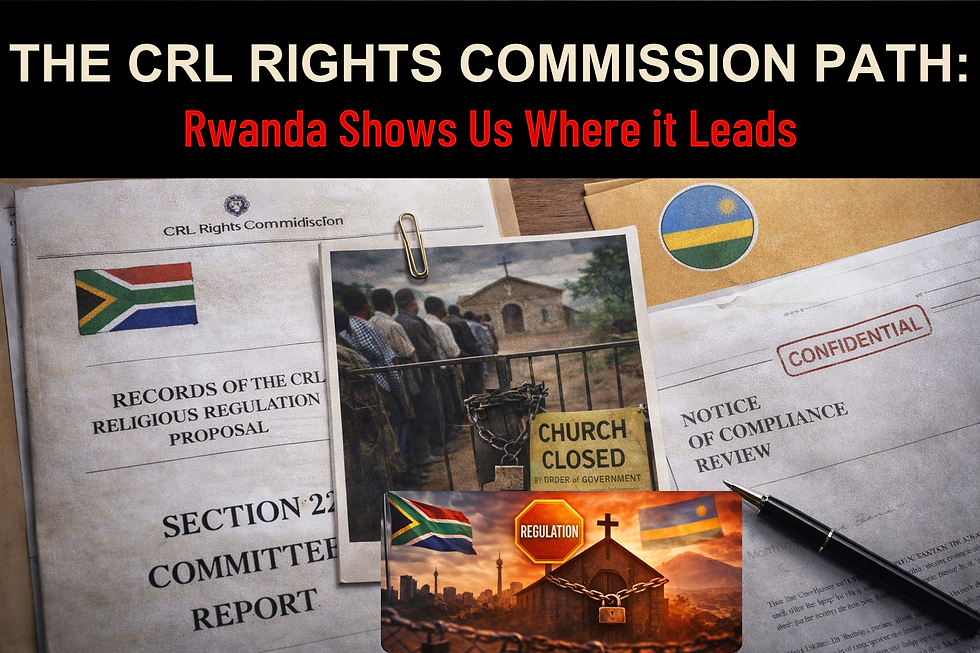


The CRL agenda is decisive and resolute. They are unmoved by oppositions or complaints from the churches or Christian organizations. Hence it calls for serious reactions, concerted efforts and relentless strategies to frustrate their actions. May the the Lord give us wisdom on how to do this tirelessly ....
Mrs. Xaluva and Xulu must come clean to the public of South Africa and say it clearly what exactly is their agenda to regulate the church because the Sihle Subisi abuse story is the weakest excuse. There is nothing called religious crime, crime is crime in RSA irrespective of where it happens and there are laws to deal with all manner of crimes.