THE CRL RIGHTS COMMISSION PATH: RWANDA SHOWS WHERE IT ENDS
- SACD MEDIA

- Jan 7
- 3 min read
WHAT WE ARE BEING TOLD FROM INSIDE RWANDA
Rwanda offers a clear and sobering lesson for South Africa.
Over the past several years, more than 10,000 churches in Rwanda have been officially closed. These closures did not come through an outright ban on Christianity, nor through a declaration that faith itself was unlawful.
We have received direct confirmation from reliable sources within Rwanda, including pastors and church leaders affected by these regulations, that many churches genuinely attempted to comply with the requirements imposed on them.
Despite these efforts:
Churches continued to be closed
Compliance did not guarantee protection
Pastors became increasingly afraid to speak publicly
Those who raised concerns faced opposition and pressure from government authorities
According to these sources, the reality facing churches in Rwanda is blunt and unambiguous:
Churches are given only two options:Comply fully with state regulations — or be shut down.
There is no meaningful space for objection, appeal, or public resistance.
Church leaders report that:
Congregations have been closed while still attempting to align
Pastors who speak out are labelled as uncooperative or problematic
Silence within the Church is driven by fear, not agreement
Survival now depends on submission to regulation rather than freedom of calling
On good authority, South African Church Defenders states that churches and pastors in Rwanda are being actively opposed through regulatory power, not criminal prosecution, and that compliance has become a condition for survival.
When pastors are afraid to speak, freedom is already gone.
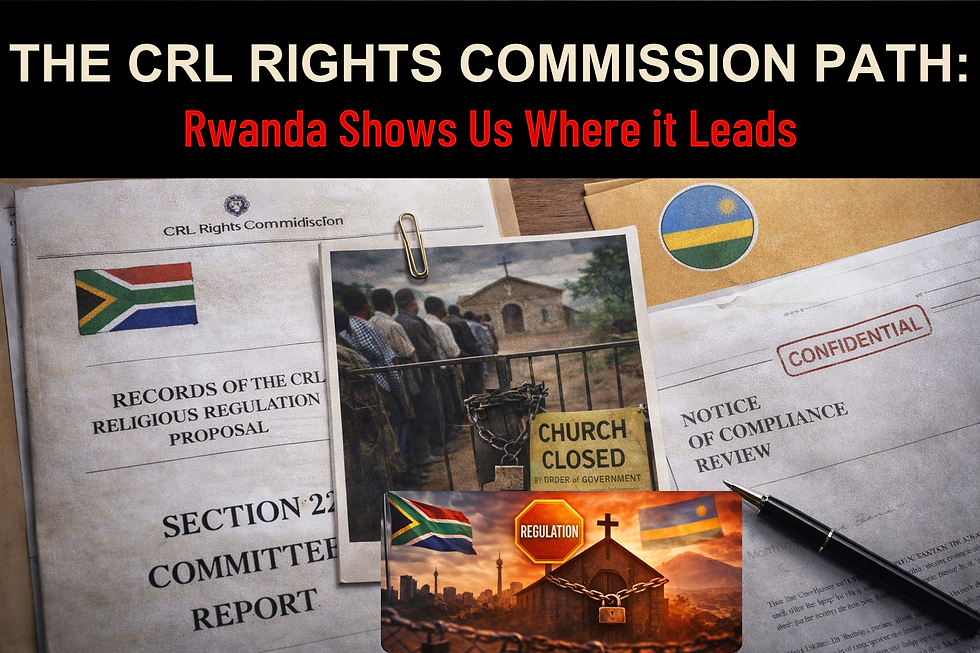
South African Church Defenders warns that the regulatory path being advanced by the CRL Rights Commission in South Africa closely mirrors the framework that led to mass church closures in Rwanda.
RWANDA: HOW REGULATION CLOSED THOUSANDS OF CHURCHES
Rwanda’s approach did not begin with hostility toward religion. It began with administrative control, introduced under the language of order, protection, and accountability.
Through law and regulation, churches were required to comply with an extensive framework, including:
Government approval to operate as a church
Certification of church buildings according to state standards
Submission of doctrinal documents and governance structures
Alignment of church activities with government development priorities
Mandatory theological qualifications for pastors
State oversight of church finances and donors
Heavy application fees, fines, and penalties
Closure of churches that failed to comply
Thousands of churches—especially independent, township, rural, and grassroots congregations—were unable to meet these requirements and were shut down administratively.
Not because they were criminal.But because they were non-compliant.
THE CRL RIGHTS COMMISSION: THE SAME DIRECTION, DIFFERENT STAGE
South Africans are repeatedly assured that the CRL Rights Commission does not intend to regulate religion.
Yet the Commission’s public statements, inquiry processes, and policy positions point in a different direction.
The CRL Rights Commission has consistently advocated for:
Registration and oversight of churches
Accreditation or licensing of pastors
“Peer-review” structures with disciplinary authority
Codes of conduct enforced through regulatory mechanisms
Monitoring of church finances and offerings
Closure of churches deemed non-compliant
This is not neutral oversight.It is regulatory control.
THE PATTERN IS UNMISTAKABLE
Rwanda shows exactly how this process unfolds:
Abuse cases are highlighted
Regulation is introduced as protection
Compliance becomes mandatory
Non-compliance becomes punishable
Churches close — legally, quietly, administratively
No bans.No soldiers.Just permits, paperwork, penalties, and fear.
WHY THE CHURCH SHOULD BE ALARMED
Once the state claims authority to decide:
Who may preach
What qualifies a pastor
Which doctrines are acceptable
How offerings may be given
Which churches may operate
The Church ceases to be free.
It becomes a licensed entity, existing by permission rather than by constitutional right.
Rwanda demonstrates the end of this road.
THIS IS NOT ABOUT DENYING ABUSE
South African Church Defenders does not deny that abuse exists, nor that accountability is necessary.
But there is a critical distinction that must never be blurred:
Criminal conduct must be dealt with through existing criminal law.Faith must never be governed through licensing.
When regulation replaces prosecution, innocent churches pay the price.
THE WARNING TO SOUTH AFRICA
South Africa is not Rwanda.
But paths matter.
And the path being proposed by the CRL Rights Commission is the same path that has already resulted in thousands of churches being closed elsewhere on the continent.
History teaches us this truth:
Once regulation becomes normal, closure becomes inevitable.
LEARN BEFORE IT IS TOO LATE
Rwanda shows where the CRL Rights Commission path ends.
Not in reform.Not in protection.But in control, compliance, fear, and closure.
The Church must decide now:
Will we defend freedom while it still exists?
Or explain silence after churches begin closing?
For Christ. For Freedom. For the Church.South African Church Defenders (SACD)


Comments